The Counter-Drone Imperative: Why Defense Is Harder Than Offense.
Asymmetric economics favor attackers. A $500 drone can threaten assets worth millions. We analyze why current defensive solutions fail and where the next generation of scalable tech must focus.
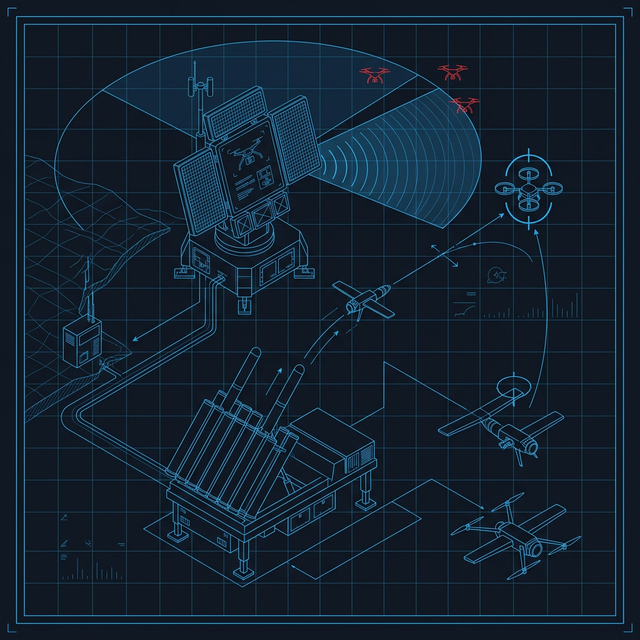
The proliferation of small unmanned aerial systems (sUAS) has introduced the most severe tactical asymmetry in modern military history. Low-cost, commercially derived drones are destroying armored vehicles, threatening naval assets, and penetrating sovereign airspace with near impunity.
Defeating this threat is not simply a matter of scaling existing air defenses. Counter-drone (C-UAS) is fundamentally harder than offensive drone operations, and closing this operational gap demands a complete overhaul of defense manufacturing economics.
Key Takeaways
- Asymmetric economics favor attackers: a $500 drone can neutralize a multi-million-dollar tactical platform, rendering legacy missile interceptors economically unsustainable.
- Counter-drone is technically harder than drone offense: defenders face multi-spectral challenges across detection, classification, tracking, and directed defeat.
- The market is early, fragmented, and under-scaled: creating massive opportunities for integrated systems manufactured with commercial speed and military reliability.
The Threat Is No Longer Theoretical
In October 2019, a coordinated swarm of low-cost drones struck the Abqaiq and Khurais oil processing facilities in Saudi Arabia, temporarily taking offline 5.7 million barrels of daily crude output: half the kingdom's production. The drones bypassed billions of dollars in Patriot missile batteries designed for high-altitude ballistic threats. The attackers spent tens of thousands of dollars: the damage totaled billions.
That strike was not an anomaly: it was a doctrinal inflection point.
Across modern battlefields, commercial quadcopters and first-person-view (FPV) loitering munitions have rewritten tactical warfare. Drones coordinate artillery strikes in real time, drop shaped charges into armored hatches, and hunt infantry across contested frontlines. Beyond active combat zones, unauthorized drones have grounded commercial airports, surveilled critical energy grids, and penetrated sensitive government facilities.
The drone revolution has fully arrived. The counter-drone industrial base has not.
Deconstructing the Asymmetry
To understand why counter-drone technology is so difficult, one must evaluate the core operational asymmetries:
Cost Asymmetry A combat-ready FPV drone costs between $500 and $2,000. Traditional kinetic interceptors cost between $50,000 and $1,000,000 per round. Firing high-cost munitions to defeat expendable swarms guarantees economic defeat long before tactical inventories run dry. The cost per defeat must fall toward near-zero.
Detection Asymmetry Small drones possess minimal radar cross-sections: comparable to small birds. They fly below 400 feet, masking within ground clutter and radar horizon limits. They emit negligible acoustic signatures and minimal thermal output. Detecting them before they enter weapon-release range pushes radar, RF, and electro-optical physics to their limits.
Time Asymmetry Attackers choose the launch window, azimuth, and ingress vector. Defenders must maintain continuous, 360-degree vigilance: 24 hours a day, 365 days a year. The defender must achieve 100 percent interception: the attacker only needs a single penetration.
Technical Adaptation Asymmetry The commercial drone ecosystem iterates on weeks-long cycles. In response to RF jamming, operators shift to frequency-hopping, autonomous inertial navigation, and tethered fiber-optic control lines that render electronic jamming obsolete. Defensive architectures developed on multi-year defense acquisition timelines cannot counter threats that evolve monthly.
The Technical Bottlenecks
Building effective counter-drone systems requires solving four compounding engineering challenges in real time:
- Multi-Sensor Fusion: No single sensor suffices. Radars detect range but struggle with low-altitude classification. RF sensors locate control links but fail against autonomous or fiber-optic drones. Optical and thermal cameras verify targets but suffer from atmospheric distortion. Effective systems must fuse RF, radar, acoustic, and thermal telemetry at the tactical edge.
- Edge Classification: Systems must differentiate between commercial air traffic, birds, and hostile loitering munitions within milliseconds. High false-alarm rates exhaust defensive units: false negatives produce catastrophic losses.
- High-Speed Tracking: Agile FPV drones execute high-G evasive maneuvers. Maintaining track fidelity with sub-milliradian precision requires dedicated hardware-accelerated computer vision and predictive tracking algorithms.
- Non-Kinetic Defeat: Directed energy weapons, high-power microwaves, and specialized optical countermeasures offer speed-of-light defeat with negligible cost per shot. However, they require extreme thermal management, ruggedized beam-directors, and precise optomechanical fabrication capable of surviving tactical environments.
The Market Landscape and Industrial Gap
The global counter-UAS market is projected to expand from $2 billion to over $15 billion by 2030. Yet the existing industrial base cannot meet current demand:
- Prime Contractors: Legacy defense primes offer exquisite, vehicle-mounted systems designed for conventional air defense. These systems carry price tags in the tens of millions and lead times stretching two to three years. They are ill-suited for distributed squad-level protection or municipal critical infrastructure.
- Component Startups: An array of venture-backed startups produce isolated point solutions: RF sensors, handheld jammers, or visual cameras. Without integrated command and control (C2) and ruggedized manufacturing, these point products fail under combat conditions.
The decisive market opportunity belongs to agile defense developers who design fully integrated, multi-spectral systems and pair them with scalable domestic manufacturing capacity.
The Subutai Thesis on Counter-UAS
Defeating asymmetric drone threats requires a manufacturing model built for low-to-mid volume precision, rapid hardware iteration, and mission-critical reliability:
- Integrated Multi-Layer Architectures: Systems that combine RF detection, AI-driven optical tracking, and directed optical defeat into compact, man-portable form factors.
- Cost-Inverting Defeat Mechanisms: Deploying directed energy, smart net-captures, and multi-spectral laser countermeasures that eliminate reliance on expensive kinetic interceptor supply chains.
- Scalable Domestic Capacity: Bypassing legacy aerospace lead times by utilizing secured, ITAR-compliant foundries to deliver operational hardware at tactical velocity.
The asymmetry of modern warfare will not correct itself. The defenders must achieve parity: and Subutai is deploying the capital, engineering, and manufacturing capacity required to make that happen.